The Difference Between IT Support and IT Partnership

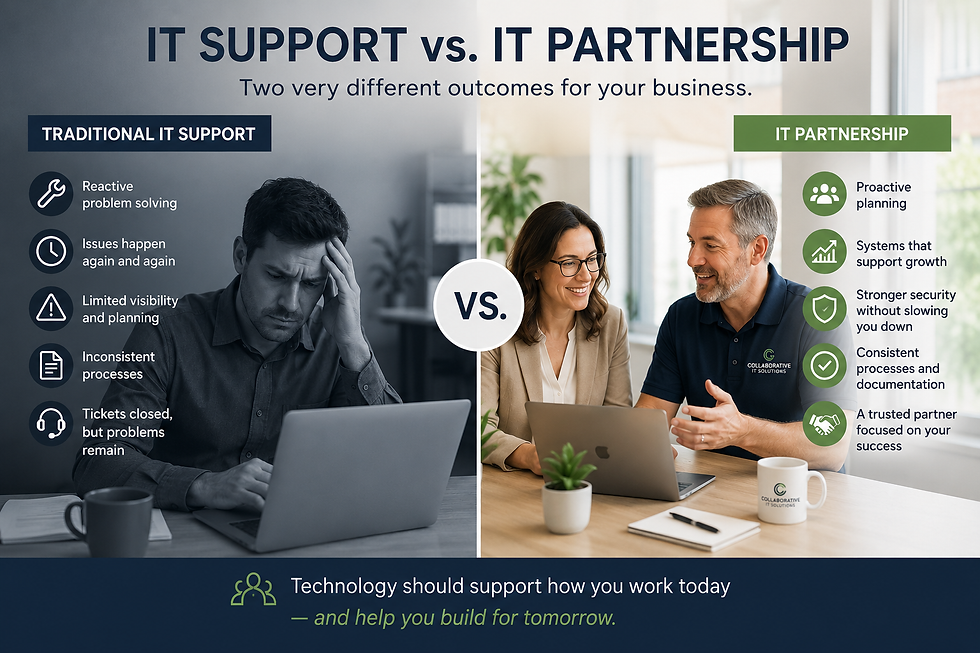
Most businesses start with reactive IT support.
Something breaks, someone fixes it, and everyone moves on.
For smaller organizations, that approach often works well enough in the beginning. But as businesses grow, add remote employees, adopt cloud platforms, and rely more heavily on technology for daily operations, “fixing problems when they happen” stops being enough.
Modern businesses need more than technical support. They need technology that actively supports the way they operate.
That’s the difference between traditional IT support and a true IT partnership.
What Traditional IT Support Looks Like
Traditional IT support is usually reactive by design.
The focus is on resolving immediate technical issues:
Password resets
Printer problems
Software crashes
Internet outages
New computer setups
There’s nothing inherently wrong with this model. Businesses absolutely need responsive technical support when issues arise.
The problem is that reactive support alone rarely addresses the larger operational challenges that growing businesses face.
Over time, this can lead to:
Repeated recurring problems
Inconsistent systems between employees
Security gaps
Poor onboarding and offboarding processes
Software sprawl
Limited documentation
Technology decisions made without long-term planning
Eventually, businesses find themselves constantly reacting to technology instead of benefiting from it.
What an IT Partnership Looks Like
An IT partnership takes a broader view.
Instead of only focusing on individual technical issues, the goal becomes helping the business operate more effectively through technology.
That includes:
Standardizing systems and processes
Improving security without disrupting workflows
Planning for growth and scalability
Supporting remote and hybrid teams
Reducing operational friction
Improving visibility into technology systems
Helping leadership make informed technology decisions
A good IT partner doesn’t just ask, “How do we fix this problem?”
They also ask:
Why did this happen?
How can we prevent it in the future?
Is the current process still serving the business well?
Are employees able to work efficiently and securely?
That shift in perspective changes the relationship entirely.
Signs a Business Has Outgrown Reactive IT Support
Many businesses don’t realize they’ve outgrown their current IT model until operational issues start piling up.
Some common signs include:
The same technical problems keep resurfacing
Employees create workarounds to get their jobs done
Security policies interfere with productivity
New employee onboarding feels inconsistent
Leadership lacks visibility into systems and risks
Different employees use different tools for the same tasks
Technology decisions are made reactively under pressure
These aren’t just technical problems. They’re business problems.
And they usually require a more strategic approach than break-fix support alone can provide.
Technology Should Support the Business — Not Complicate It
One of the biggest misconceptions in IT is that more technology automatically means better operations.
In reality, overly complex systems often create more friction, more confusion, and more risk.
Businesses usually benefit more from:
Clear standards
Thoughtful planning
Reliable systems
Practical security measures
Technology that fits how employees actually work
The best IT environments are often the ones employees barely notice because everything works consistently and predictably.
The Best IT Relationships Feel Collaborative
Strong IT partnerships are built on communication, trust, and alignment with business goals.
The relationship becomes less transactional and more collaborative.
Instead of functioning as an outside vendor that only appears when something breaks, IT becomes an ongoing operational resource that helps the business adapt, grow, and improve over time.
That doesn’t mean businesses need enterprise-level complexity or massive technology budgets.
It means they need technology decisions that are intentional, sustainable, and aligned with how the organization actually operates.
Final Thoughts
Most businesses don’t necessarily need more technology.
They need technology that supports productivity, reduces friction, improves security, and scales alongside the business.
Reactive support will always have its place. But modern businesses often benefit most from an IT relationship that goes beyond fixing problems and focuses on helping the organization operate more effectively as a whole.


Comments