Traditional IT Support Models Don’t Work for Modern Businesses

Modern businesses don’t operate from a single office anymore.
Teams are distributed across cities, states, and time zones. Employees work from home, shared offices, client sites, and coffee shops. Independent contractors collaborate alongside full-time staff. Critical business systems live in the cloud instead of a server closet down the hall.
But despite all of that change, many IT support models still operate as though every business works the way it did in 2005.
That disconnect creates frustration for growing organizations.
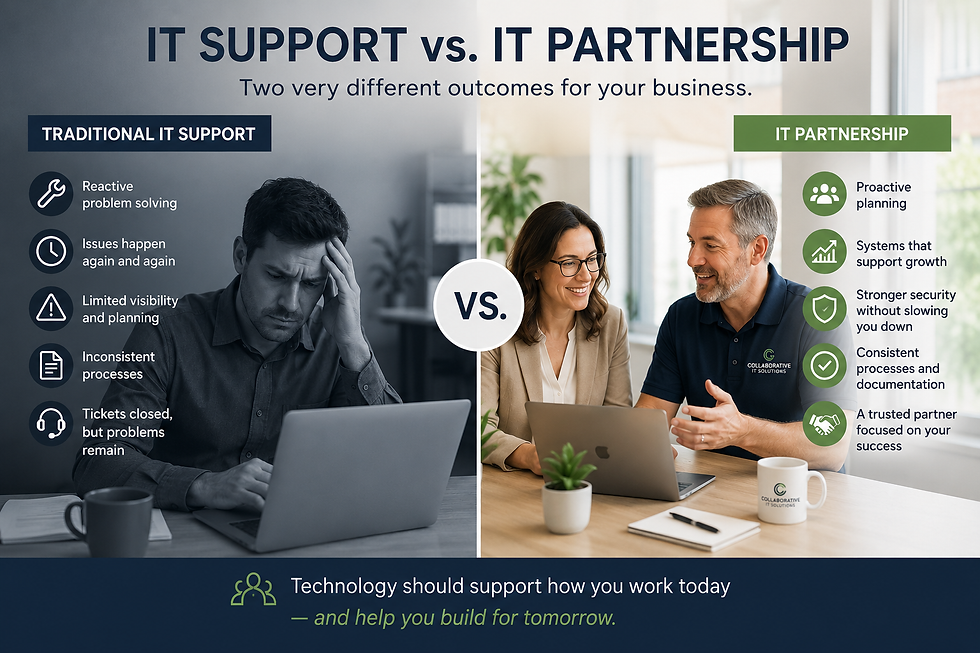
The Problem With Traditional IT Support
Traditional MSP (Managed Service Provider) models are often built around rigid systems, ticket queues, and standardized processes designed for large-scale volume.
For some organizations, that structure works.
But for many growing businesses, it creates new problems:
Slow response times
Overly complex support systems
Lack of strategic guidance
Poor communication
Solutions that prioritize standardization over usability
Technology decisions disconnected from real operational needs
Businesses don’t just need “someone to fix computers.”
They need technology systems that support the way their teams actually work.
Modern Businesses Need Flexible Technology Support
A remote-first company has very different operational needs than a traditional office.
A contractor-based organization requires different onboarding, security, and communication workflows than a business with only in-house employees.
A growing professional firm needs scalable systems that won’t break every time the business evolves.
Technology support should reflect those realities.
That means:
Cloud-first infrastructure
Secure remote access
Practical cybersecurity policies
Device flexibility
Microsoft 365 collaboration systems
Clear communication
Strategic planning
Responsive human support
Most importantly, it means understanding the business behind the technology.
Technology Should Support Operations — Not Complicate Them
One of the biggest issues we see is unnecessary complexity.
Businesses are often sold enterprise-level systems they don’t actually need, or forced into support models that create friction instead of reducing it.
Good technology strategy should simplify operations.
It should help teams communicate more effectively, collaborate more easily, and scale more confidently.
That requires more than technical knowledge alone. It requires understanding workflows, operational realities, and the human side of technology adoption.
A Partnership Model Works Better
At JJB Collaborative IT Solutions, we believe technology support works best as a partnership — not a transaction.
That means:
learning how your business operates
understanding your long-term goals
building systems around real workflows
communicating clearly
staying responsive
creating solutions that evolve alongside your business
We work with growing businesses, distributed organizations, hybrid teams, and contractor-based companies that need practical technology guidance without unnecessary complexity.
Because modern businesses deserve technology support designed for the way they actually operate today — not the way companies operated twenty years ago.
--
Need a More Strategic Approach to IT Support?
Whether you're managing a remote workforce, modernizing your Microsoft 365 environment, or building scalable systems for growth, we help businesses create practical technology solutions that support long-term success.

Comments